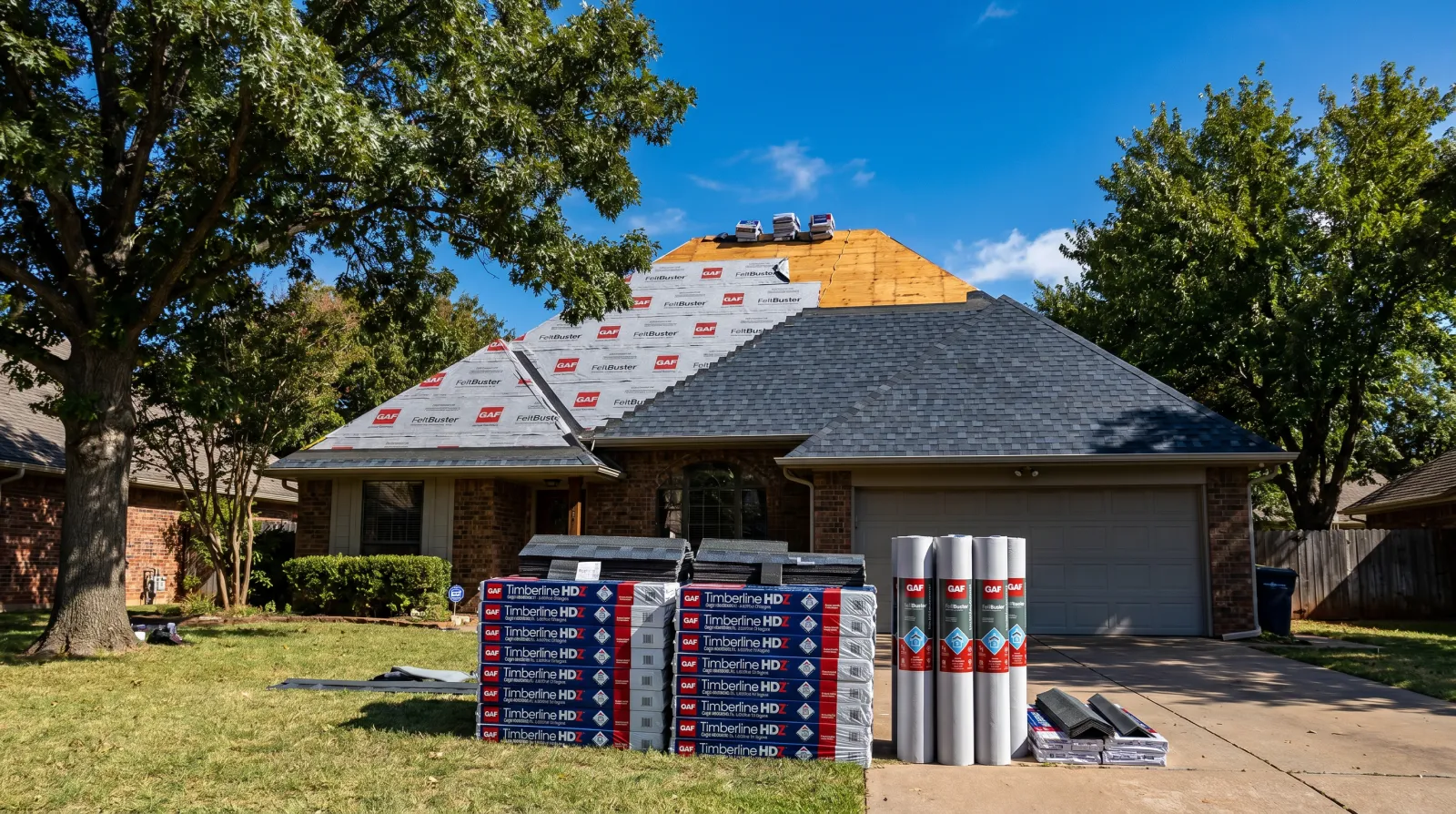
A full replacement typically takes one to three days for a 2,000 sq ft Oklahoma home
Short answer: Most Oklahoma homeowners replacing a roof in 2026 will spend $8,500–$22,000 on standard architectural asphalt shingles, $11,000–$28,000 on Class 4 impact-resistant shingles, and $18,000–$42,000+ on standing-seam metal. The work itself takes 1–4 days for asphalt and 3–6 days for metal. Every Oklahoma city requires a building permit for full replacements, and a complete quote should itemize 12–15 specific line items (tear-off, underlayment, drip edge, ice-and-water shield, flashing, ventilation, warranty terms). The best time to replace is August through November.
Key Facts at a Glance
Asphalt architectural replacement (typical OK home): $8,500–$22,000
Class 4 impact-resistant upgrade: $11,000–$28,000
Standing-seam metal: $18,000–$42,000+
Typical asphalt timeline: 1–2 days (longer for complex roofs)
Permit required: yes, in every Oklahoma city for full replacement
Best replacement season: August through November
Manufacturer warranty range: 20–50 years (material-only); workmanship 5–25 years
Replacement is the right call in Oklahoma when one or more of these are true:
The roof is past 15 years on standard asphalt shingles. Even a "good-looking" 18-year-old roof in Oklahoma is near end of life from cumulative UV and granule loss.
More than 25–30% of slopes have visible damage. This is the threshold most insurance carriers use to scope a full replacement vs a partial.
Decking is wet or rotted. Once moisture is in the OSB or plywood beneath the shingles, you're past patching.
You're chasing the same leak more than twice. The water path is hiding something the eye can't see from the attic.
An insurance adjuster has approved full replacement. Storm-damage replacements are the most common replacement path in Oklahoma.
You're selling the home and the inspection flagged the roof. Buyers' lenders increasingly require a roof report; a marginal roof can kill financing.
The numbers below are for installed cost in Oklahoma metros as of 2026, including labor, tear-off, basic underlayment, standard flashing, and disposal. Decking replacement (if needed), upgraded underlayment, and complex flashing situations push totals higher.
Home Size (Roof Area)
Architectural Asphalt
Class 4 Impact-Resistant
Standing-Seam Metal
Small (1,400 sq ft roof)
$6,500–$11,500
$9,000–$15,000
$14,000–$22,500
Medium (2,000 sq ft roof)
$9,200–$16,500
$13,000–$21,500
$20,000–$32,000
Large (2,800 sq ft roof)
$13,000–$23,000
$18,000–$30,000
$28,000–$45,000
Very large (3,500+ sq ft roof)
$16,500–$30,000+
$23,000–$38,000+
$35,000–$58,000+
Two roofs of identical square footage can vary by $4,000–$10,000 because of: pitch steepness (above 8:12 adds 20–35%), number of stories, number of penetrations (chimneys, skylights, dormers, vents), tear-off layers (single layer is standard; double layer doubles disposal cost), decking condition, and whether ventilation upgrades are required to meet current code.
For the deepest OKC-specific cost breakdown — including per-square-foot ranges, post-storm pricing surges, and worked insurance examples — see the Oklahoma City roof cost guide.
Materials comparison summary
Five material categories cover almost every Oklahoma residential replacement. Here's the snapshot — for a deeper look, see the Oklahoma roofing materials comparison.
Material
Lifespan in OK Climate
Hail Performance
Wind Rating
3-tab asphalt (basic)
15–20 yrs
Weak
60–70 mph
Architectural asphalt (standard)
20–25 yrs
Moderate
110–130 mph
Class 4 impact-resistant asphalt
25–30 yrs
Strong
110–130 mph
Standing-seam metal
40–50+ yrs
Strong (may dent cosmetically)
140–160 mph
Concrete or clay tile
40–50+ yrs
Variable (can crack)
110–150 mph
For Oklahoma specifically, the default high-value choice for most homeowners is Class 4 impact-resistant asphalt. The cost premium over standard architectural shingles is roughly 15–30%, and the insurance premium discount commonly offered by Oklahoma carriers — typically 10–25% off the dwelling portion of the policy — usually recoups the upgrade cost within 5–8 years. See the dedicated Class 4 shingles guide for the worked discount math.
For homeowners considering metal, the cost premium is steeper but the lifespan is roughly double. See the Oklahoma metal roofing guide for standing-seam vs exposed-fastener comparisons.
What a replacement timeline looks like
A typical asphalt shingle replacement in Oklahoma runs on this rough schedule:
Pre-installation (1–4 weeks)
Days 1–3: Initial contractor inspection, written estimate, contract signing.
Days 3–7: Material order placed (most asphalt shingles ship from regional warehouses in 1–2 weeks; specialty colors or premium products can take 3–4 weeks).
Days 7–21: Permit pulled, dumpster scheduled, installation date confirmed.
Insurance claims: add 2–6 weeks for the adjuster inspection and scope-of-loss process before pre-installation begins.
Installation (1–4 days)
Morning of Day 1: Crew arrives, dumpster delivered, materials staged, tarps protect landscaping.
Day 1: Tear-off of existing roof. On a typical 2,000 sq ft asphalt roof, a competent crew can complete tear-off and dry-in (underlayment laid) on day 1.
Day 2: Shingle installation, flashing, ridge cap, vents, final inspection by crew lead.
Larger or complex roofs: day 3–4 for finish work, valley details, and cleanup.
Post-installation
Same day or next day: Final cleanup, magnetic sweep of yard for stray nails, dumpster pickup.
Within 1 week: Final inspection by city building department.
Within 2 weeks: Manufacturer warranty registration, final invoice, certificate of completion.
Post-storm reality check: if a major hail event hit your area within the past 4–8 weeks, expect lead times to stretch 4–12 weeks for installation. Every Oklahoma roofer is booked solid for a month or more after a hail swarm hits the metro.
What to look for in an Oklahoma roof replacement quote
A complete quote should itemize each of the following. Anything missing is either bundled (ask for the line-item breakdown) or being skipped (red flag):
Tear-off scope. Number of layers being removed, including disposal of all underlayment.
Disposal / dumpster fee. Itemized, not buried in labor.
Underlayment. Type (synthetic vs felt) and brand. Synthetic is now standard; felt is an indicator of a budget bid.
Ice and water shield. Where applicable — valleys, eaves on low-slope sections, around penetrations. Required by code in many situations.
Drip edge. Color-matched aluminum at eaves and rakes. Required by current International Residential Code (IRC) and adopted in Oklahoma cities.
Starter strip. Manufacturer-specified starter shingles, not cut-down field shingles.
Shingle brand, line, and color. Specific product, not "architectural shingles." If your home has an HOA, color approval may be required.
Ridge cap. Manufacturer-matched ridge cap shingles, not cut-down field shingles.
Flashing. All chimney, sidewall, valley, and skylight flashing. New, not reused — except in some skylight scenarios.
Pipe and vent boots. New boots on all plumbing vents and roof vents.
Ventilation. Ridge vent and soffit intake or other balanced ventilation system. If your existing ventilation is inadequate, the contractor should specify the upgrade.
Decking replacement allowance. Per-sheet pricing for any rotted or damaged decking discovered during tear-off. Usually $80–$140 per sheet for materials plus install labor.
Permit fee. Specific dollar amount or a note that the contractor pulls and pays the permit.
Cleanup. Magnetic sweep of yard and driveway, dumpster removal, debris hauling.
Manufacturer warranty. Length and tier (standard vs enhanced vs extended). Enhanced warranties often require manufacturer-certified contractors.
Workmanship warranty. Contractor's warranty on installation labor. Typically 5–25 years.
Permit requirements by Oklahoma city
Every Oklahoma city we work in requires a building permit for full residential roof replacement. The permit is pulled by the contractor (not the homeowner), and a final inspection by the city building department is required when the work is complete. Permit-free roofing is a serious red flag.
City
Permit Required
Typical Fee
Code Reference
Oklahoma City
Yes, all replacements
$50–$200
OKC Development Services
Edmond
Yes, all replacements
$50–$150
Edmond Development Services
Norman
Yes, all replacements
$50–$175
Norman Building Inspections
Moore
Yes, with post-2013 wind-rated requirements
$60–$200
Moore Building Code (enhanced)
Yukon
Yes, all replacements
$50–$150
Yukon Building Department
Mustang
Yes, all replacements
$50–$150
Mustang Building Department
Midwest City
Yes, all replacements
$50–$150
Midwest City Building Inspections
Bethany
Yes, all replacements
$50–$150
Bethany Building Department
Moore is the notable Oklahoma outlier. After the May 2013 EF5 tornado, the City of Moore adopted enhanced building code requirements for residential construction — including upgraded wind-resistant fastening for roofing systems. A replacement in Moore must meet those enhanced requirements, which often means an additional pass of nails per shingle and reinforced sheathing fastening. Your contractor should know the current Moore code if they're licensed to work in the city.
Most Oklahoma cities adopt the International Residential Code (IRC) with local amendments. As of 2026, the prevailing version is IRC 2018 or 2021 with adopted amendments. The Construction Industries Board (CIB) registers contractors statewide; city permits are separate. For more on the CIB and contractor verification, see the Oklahoma roofing licenses and permits page.
Warranties: what's real and what's marketing
Roofing warranties come in three flavors, and only two of them are worth the paper they're printed on.
1. Manufacturer material warranty (real)
Asphalt shingle manufacturers — GAF, Owens Corning, CertainTeed, Atlas, Malarkey, Tamko — offer limited material warranties typically running 20–50 years depending on the product tier. Standard architectural shingles carry a "limited lifetime" warranty that's prorated heavily after year 10. Premium products (Class 4 impact-resistant, designer lines) carry longer non-prorated periods.
The catch: material warranties cover manufacturing defects, not installation defects. If a tornado tears the roof off, the warranty doesn't pay. If the installer used the wrong nail pattern and the shingles blow off, the warranty doesn't pay.
2. Enhanced manufacturer warranty (real, but conditional)
Manufacturers offer enhanced warranties through certified contractor programs (GAF Master Elite, Owens Corning Platinum, CertainTeed Select ShingleMaster). These extend coverage and add workmanship coverage from the manufacturer if installed by a certified contractor. The catch: only a small percentage of Oklahoma roofers carry these certifications.
3. Workmanship warranty (varies wildly)
The contractor's own warranty on installation. Typical Oklahoma workmanship warranties run 5–10 years for standard contractors and 15–25 years for the highest-tier certified installers. Workmanship warranties are only as good as the contractor's business continuity — a 25-year warranty from a company that goes out of business in year 6 is worthless.
Get every warranty in writing with specific terms: what's covered, what's excluded, transfer rights to a future homeowner, and the dispute process.
Insurance vs out-of-pocket replacement
The financial math is dramatically different depending on whether your replacement is storm-driven (insurance) or planned (out of pocket).
Out-of-pocket replacement
You pay the full installed cost. On a typical Oklahoma asphalt replacement, that's $8,500–$22,000 from your own funds. Financing is available through most contractors via third-party lenders (typically 12–60 month terms at 8–18% APR depending on credit).
Insurance-covered replacement
If a covered storm event damages enough of the roof, the policy typically pays the actual cash value (ACV) at the time of loss, the homeowner pays the wind/hail deductible (commonly 1–2% of dwelling coverage in Oklahoma), and the recoverable depreciation is paid after the work is completed. On a $300,000 home with a 1% deductible and a $14,000 replacement cost, the homeowner pays $3,000 out of pocket regardless of roof age.
For the full step-by-step claim process — documentation, adjuster prep, supplements, recoverable depreciation timing — see the Oklahoma roof insurance claim guide. For the broader legal framework including bad-faith protections and public adjuster rules, see the Oklahoma roof insurance claims overview.
Need a vetted Oklahoma roofer for your replacement?
RoofQuoteHQ matches Oklahoma homeowners with one vetted local roofer per project — no bidding wars, no spam.
How much does it cost to replace a roof in Oklahoma?
Most Oklahoma roof replacements cost between $8,500 and $22,000 for standard architectural asphalt shingles on a typical 1,800–2,800 square foot residential roof. Class 4 impact-resistant shingles run $11,000–$28,000. Standing-seam metal runs $18,000–$42,000. The wide ranges are driven by roof complexity, pitch, number of stories, and whether decking needs replacement.
How long does a roof replacement take in Oklahoma?
Most residential asphalt shingle replacements in Oklahoma take 1–2 days from tear-off to final cleanup. Larger or more complex roofs run 2–4 days. Metal roofs take longer, typically 3–6 days. Post-major-storm scheduling lead time can stretch the start date 2–8 weeks because every local crew is booked solid.
Do I need a permit to replace my roof in Oklahoma?
Yes, full residential roof replacements require a building permit in every Oklahoma city we work in — Oklahoma City, Edmond, Norman, Moore, Yukon, Mustang, Midwest City, Bethany, and the Tulsa metro. Permit fees in OKC and most metro cities run $50–$200 depending on project value. A reputable contractor pulls the permit on your behalf and includes it in the scope of work.
What is the best time of year to replace a roof in Oklahoma?
Late summer through late fall (August through November) is generally the best replacement window in Oklahoma. The severe storm season has passed, temperatures are moderate for proper shingle sealing, and lead times are shorter than in the post-spring-storm rush. Winter installations are possible but cold temperatures can affect shingle sealing — most reputable contractors hand-seal in cold weather.
What should be included in an Oklahoma roof replacement quote?
A complete Oklahoma quote should itemize: tear-off and disposal, underlayment type and brand, ice and water shield where applicable, drip edge, starter strip, shingle brand and product line, ridge cap, all flashing (chimney, sidewall, valley, skylight), pipe and vent boots, ridge and soffit ventilation, decking replacement allowance, permit fee, cleanup, manufacturer warranty registration, and the contractor's workmanship warranty terms.
How long does a new roof last in Oklahoma?
On standard architectural asphalt shingles, Oklahoma roofs typically last 15–22 years before the next replacement is needed — driven primarily by hail and UV exposure rather than installation quality. Class 4 impact-resistant shingles extend that to 22–30 years. Standing-seam metal roofs commonly last 40–50+ years in Oklahoma climate, though they may still require panel repairs after major hail.
 Coming Soon