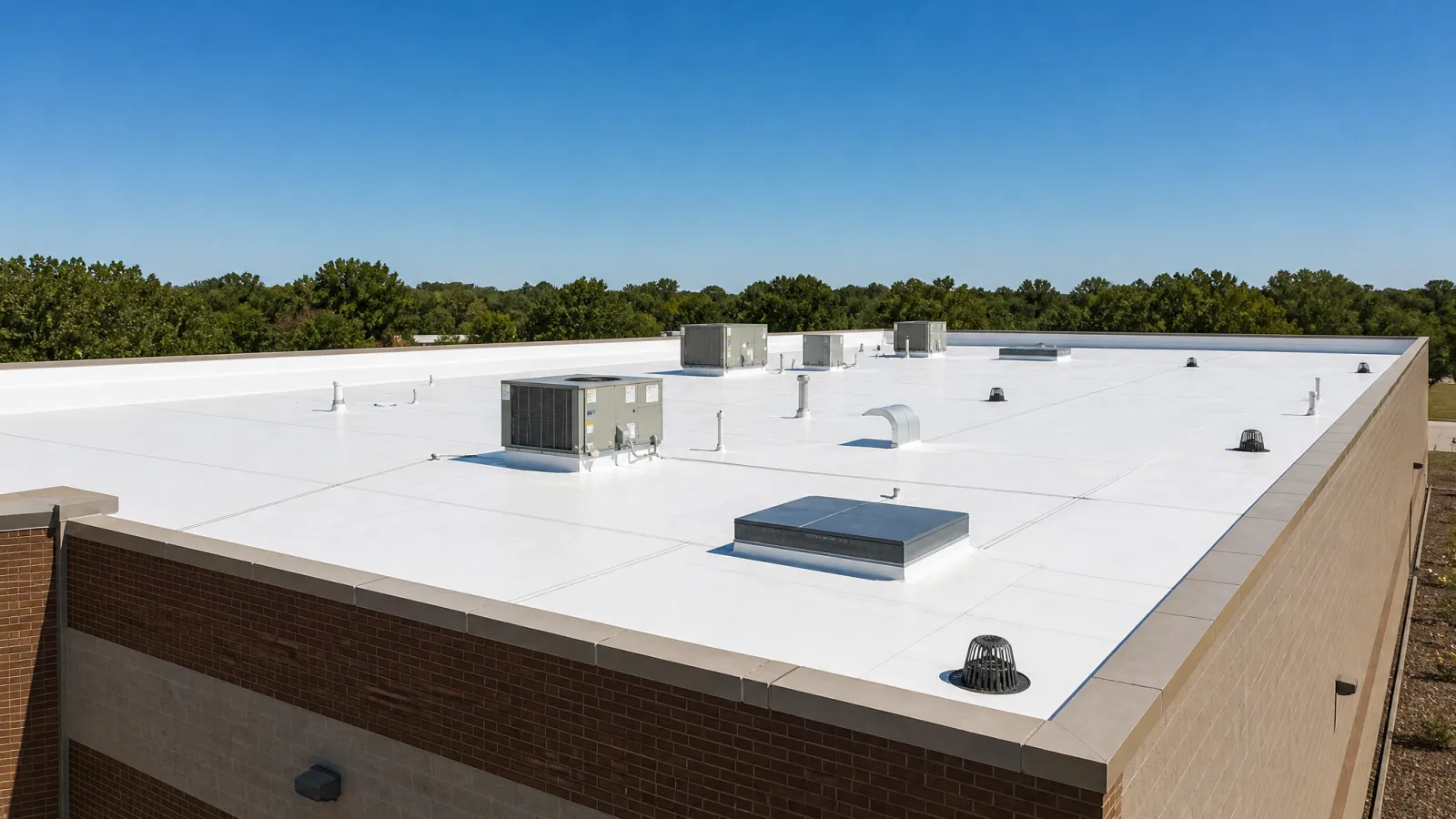
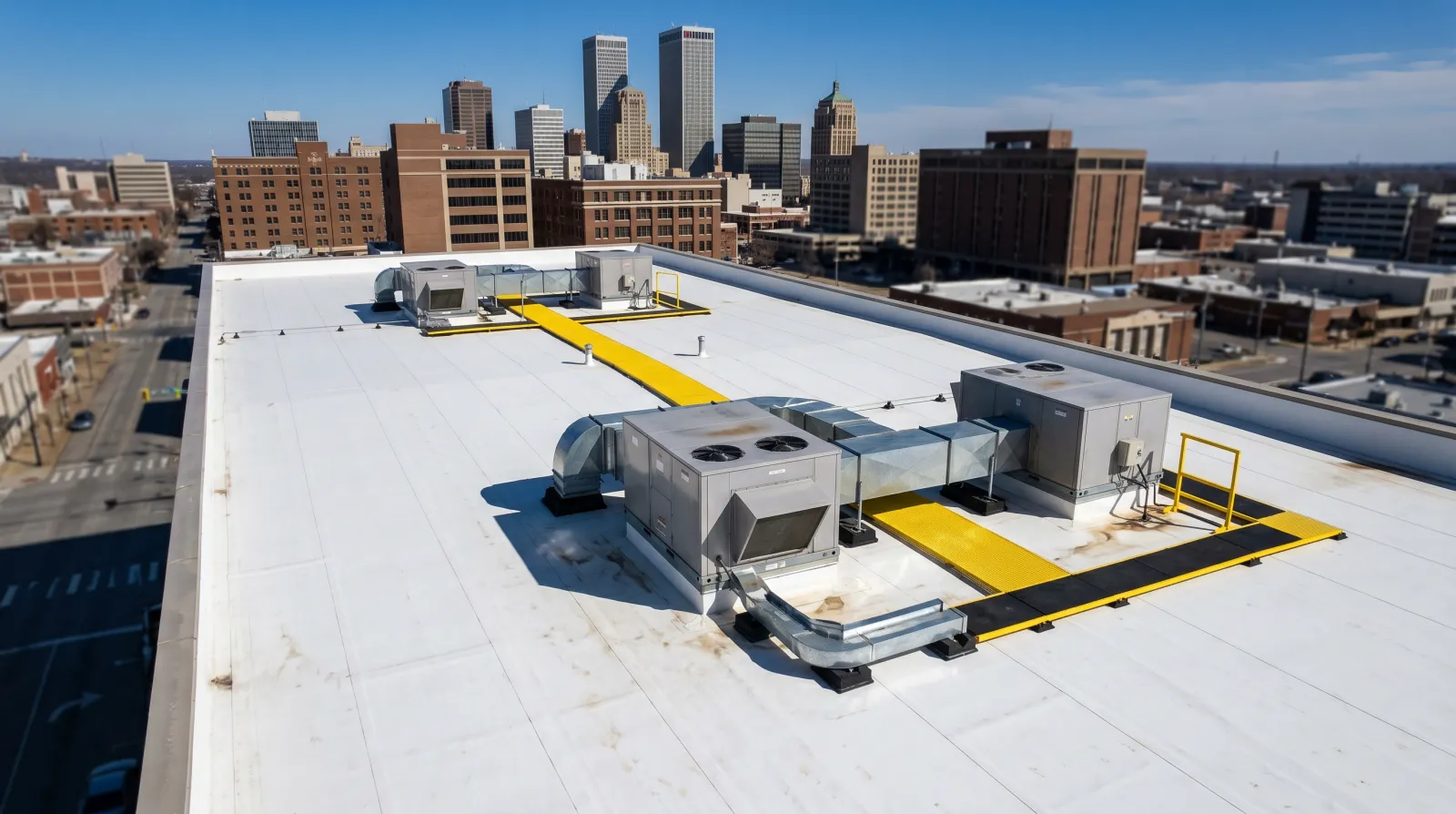
White TPO is the dominant commercial flat-roof system in Oklahoma — heat-reflective and hail-rated
Short answer: Oklahoma commercial flat roofs in 2026 are dominated by four membrane systems: TPO (the most common choice for new installs because of UV resistance, heat reflectivity, and reasonable cost), EPDM (a black rubber membrane with strong hail performance and long lifespan), PVC (premium-tier chemical and UV resistance), and modified bitumen (legacy system for budget reroofs). Installed cost typically runs $7–$15 per square foot. Restoration coatings can extend life 10–15 years at 30–60% of replacement cost. The strongest warranty structure is an NDL (No Dollar Limit) warranty, which requires installation by a manufacturer-certified contractor.
Key Facts at a Glance
Installed cost range: $7–$15 per square foot (varies by system and complexity)
TPO: most common new install in Oklahoma, $7–$12 per sq ft
EPDM: strong hail performance, $7–$11 per sq ft
PVC: premium-tier, $10–$15 per sq ft
Modified bitumen: budget choice, $6–$11 per sq ft
Typical lifespan in OK: 20–30 years depending on system and maintenance
NDL warranty term: typically 15, 20, 25, or 30 years
Restoration coating: 30–60% of replacement cost, adds 10–15 years
Oklahoma climate considerations for commercial roofs
Oklahoma is one of the most punishing commercial roofing climates in the continental US. Three weather patterns combine to drive material selection and replacement frequency:
Hail
Oklahoma sits at the southern end of "Hail Alley." Severe hail events are routine. On commercial roofs, hail damage typically shows up as: punctures through membrane (especially on older single-ply systems), crushed insulation under the membrane, broken cover boards, and bent or punctured drain bowls. Hail-resistant systems and Class 4 ratings (UL 2218) matter even more on commercial than on residential.
Heat and UV
Oklahoma surface temperatures on a dark commercial roof can exceed 160°F in summer. UV degradation is the single biggest driver of single-ply membrane aging. White (reflective) membranes substantially outperform black on lifespan in Oklahoma climate — and may qualify for ENERGY STAR or Cool Roof Rating Council recognition that reduces cooling costs by 10–25%.
Wind
Sustained 60–80+ mph wind events during severe weather pull at membrane edges, parapet flashing, and mechanically attached fasteners. Wind uplift design is governed by ASCE 7 and is critical for any commercial roof in Oklahoma. Fastener patterns, edge metal, and seam strength all factor in.
Freeze-thaw
Oklahoma winters bring repeated freeze-thaw cycles. Water that penetrates a membrane and freezes overnight expands cracks, separates seams, and saturates insulation. Membranes that brittle in cold (some older modified bitumen products) perform worse than membranes that retain flexibility (good EPDM, modern TPO).
TPO: the dominant new-install choice
TPO (thermoplastic polyolefin) is now the most commonly specified commercial flat-roof membrane for new installations in Oklahoma. It became the dominant single-ply system in the US over the past 15 years for a few reasons specific to climates like Oklahoma:
White by default. TPO is typically white, which dramatically reduces surface temperature in Oklahoma summers and lowers cooling costs.
Heat-welded seams. TPO seams are hot-air welded rather than adhered or taped. Welded seams typically outperform adhered seams in Oklahoma heat and freeze cycles.
Reasonable cost. Installed cost is typically $7–$12 per square foot, lower than PVC and competitive with EPDM.
Wide manufacturer support. GAF, Carlisle, Versico, Johns Manville, Firestone (now part of Holcim/Elevate), and others all offer TPO with strong NDL warranty programs.
When TPO is the right choice
New commercial construction or full replacement
Buildings with heavy summer cooling loads (offices, retail, schools)
Owners who want energy-efficient cool-roof certification
Projects requiring 20–30 year NDL warranty coverage
TPO limitations
Membrane is relatively thin compared to multi-ply systems; punctures require prompt repair
Earlier-generation TPO (pre-2010) had some weathering issues at seams; current formulations have largely addressed this
Welded seams require skilled installation — quality varies more by installer than the material itself
EPDM: the durable rubber membrane
EPDM (ethylene propylene diene monomer) is a synthetic rubber membrane that's been the workhorse of commercial flat roofing in the US since the 1970s. In Oklahoma, EPDM remains a strong choice especially for hail-prone properties and for retrofits over existing systems.
Excellent hail performance. EPDM's flexibility absorbs hail impact better than rigid systems. A 1-inch hailstone may dent or stretch an EPDM membrane without puncturing it.
Long lifespan. Well-maintained EPDM commonly lasts 25–30+ years in Oklahoma climate.
Strong cold-temperature performance. Stays flexible at low temperatures, important for Oklahoma freeze cycles.
Multiple attachment options. Can be ballasted, mechanically attached, or fully adhered depending on building structure.
EPDM limitations in Oklahoma
Black is standard. Heat absorption is significantly higher than white TPO/PVC. White EPDM is available but at a cost premium.
Adhesive seams. Older EPDM seams are tape-and-adhesive rather than welded; modern formulations have improved seam tape performance but still trail TPO welded seams in some longevity studies.
Petroleum sensitivity. Kitchen exhaust grease, HVAC condensate with petroleum residue, or roof traffic with petroleum products can degrade the membrane.
PVC: premium chemical and UV resistance
PVC (polyvinyl chloride) is the premium-tier single-ply system. It's the strongest performer for restaurants, manufacturing facilities, hospitals, and any building with chemical or grease exposure on the roof.
Excellent UV and chemical resistance. Outperforms TPO and EPDM in most chemical-exposure environments.
White-membrane heat reflection. Like TPO, PVC is typically white and qualifies for cool-roof recognition.
Welded seams. Hot-air welded like TPO, producing strong durable seams.
Long lifespan with proper maintenance. 25–30+ years is realistic in Oklahoma climate.
When PVC is the right choice
Restaurants with kitchen exhaust fans (grease exposure)
Manufacturing facilities with chemical exhaust
Hospitals and labs
Buildings where membrane longevity outweighs upfront cost
PVC limitations
Highest cost of the four major systems: $10–$15 per sq ft installed
Plasticizer migration over very long periods can affect flexibility (modern formulations have largely mitigated this)
Fewer manufacturers and certified installers than TPO; selection of contractors is narrower in some Oklahoma markets
Modified bitumen: the legacy budget system
Modified bitumen ("mod bit") is a multi-ply asphalt-based system. It's the descendant of traditional built-up roofing (BUR) and remains a viable choice for budget-conscious reroofs, especially smaller buildings or those where matching an existing modified bitumen system simplifies repair logistics.
Multi-ply redundancy. Typically 2–3 plies plus a granulated cap sheet. The redundancy provides puncture resistance superior to thin single-ply membranes.
Reasonable cost. $6–$11 per sq ft installed makes it the most affordable proper commercial system.
Familiar installation. Many smaller Oklahoma roofers carry mod bit experience.
Modified bitumen limitations in Oklahoma
Shorter lifespan. 15–25 years vs 25–30+ for premium single-ply.
Heat absorption. Most mod bit cap sheets are dark (granulated), which raises surface temperature substantially.
Torch-applied installations have fire risk. Some mod bit systems are heat-applied with a torch — fire-safety protocols matter, and some Oklahoma cities have stricter rules on torch-applied systems.
Hail performance varies. Cap sheet granule loss under hail is similar to asphalt shingles; underlying plies are more puncture-resistant.
Restoration coatings vs replacement
Roof restoration is one of the most underused options in Oklahoma commercial roofing. When the existing membrane is structurally sound but aging, a fluid-applied elastomeric coating can extend the roof's useful life by 10–15 years at 30–60% of replacement cost.
How a restoration coating works
The existing roof is inspected, cleaned, and any failed seams, punctures, or saturated insulation are repaired.
A primer or base coat is applied.
A topcoat (typically white silicone, acrylic, or polyurethane elastomeric) is applied at the manufacturer-specified mil thickness.
Reinforcement fabric is embedded over seams and penetrations.
The new coating is reflective white, dramatically reducing surface temperatures.
When restoration is the right call
The existing membrane is more than 70% structurally sound (no widespread wet insulation, no major punctures)
The roof is 8–18 years old — restoration extends life rather than replacing prematurely
The building owner wants to avoid disruption of operations during a full tear-off
The owner wants the energy-cost benefit of a white reflective coating
The capital budget for full replacement isn't available this year
When restoration is NOT the right call
The existing insulation is wet across more than 25% of the roof (moisture trapped under a coating creates more problems)
The deck itself is compromised (rotted plywood, rusted steel deck)
Multiple previous coatings have already been applied (each layer reduces the next coating's bond strength)
The existing system is past warranty with active leaks that aren't isolated
A moisture survey (typically infrared scan or capacitance reading) before deciding between restoration and replacement is a small investment ($0.05–$0.10 per sq ft) that prevents large mistakes.
Warranty structures including NDL
Commercial roofing warranties are fundamentally different from residential. The three major commercial warranty tiers, in ascending order of strength:
1. Material warranty (basic)
The manufacturer warrants the membrane against material defects only. Typically 10–20 years. Excludes labor, removal, and replacement costs. This is roughly equivalent to an asphalt shingle warranty on a residential roof.
2. Material and labor / system warranty
The manufacturer covers material defects and a capped portion of replacement labor — typically expressed as a dollar limit per square foot or a total cap. Requires installation by an approved contractor following manufacturer specifications.
3. NDL — No Dollar Limit
The strongest commercial warranty available. The manufacturer commits to repair or replace the failed membrane at no additional cost to the building owner for the duration of the warranty term — typically 15, 20, 25, or 30 years — without a per-square-foot or total dollar cap.
NDL warranties are offered by major manufacturers: GAF (Diamond Pledge NDL), Carlisle (Total Roof System), Versico, Johns Manville, Sika Sarnafil, and others. Requirements typically include:
Installation by a manufacturer-certified contractor (Master Select, Authorized Applicator, etc.)
Manufacturer technical representative on-site for some portion of the installation
Periodic manufacturer inspections during the warranty term (often years 2, 5, 10, 15)
Owner adherence to specified maintenance practices
Use of manufacturer-supplied components throughout (insulation, fasteners, coverboard, accessories)
NDL exclusions to watch for
"No Dollar Limit" doesn't mean "no exclusions." Common NDL exclusions:
Acts of God — including tornados and "extreme weather"
Hail above a stated size threshold — many NDL warranties exclude hail above 1.25 to 2 inches
Owner-installed equipment penetrations after the original installation
Failure to maintain per manufacturer schedule
Modifications by non-certified contractors
In Oklahoma specifically, the hail-size exclusion is the one to read carefully. Some NDL warranties exclude hail above 1.25 inches — a threshold Oklahoma hits multiple times per year in most metros.
Selecting a commercial roofer in Oklahoma
Commercial roofing contractor selection is more nuanced than residential. The non-negotiables:
Oklahoma Construction Industries Board (CIB) registration. Same body that registers residential contractors.
Manufacturer certification for the specific system you're installing. If you want a GAF NDL warranty, you need a GAF Master Select contractor. If you want Carlisle, you need a Carlisle Authorized Applicator. The certification list is on each manufacturer's website.
General liability and workers' comp. Commercial projects typically require $2M+ liability minimum.
OSHA compliance program. Documented fall protection, safety training, and incident history.
References for similar projects. A contractor who does 5,000 sq ft retail strips isn't necessarily the right pick for a 50,000 sq ft warehouse.
RoofQuoteHQ note: RoofQuoteHQ's current vetted network focuses primarily on residential matches in the OKC metro. For larger commercial reroof projects, we can help identify qualified Oklahoma commercial contractors but vetting depth varies. Contact us directly for commercial project referrals.
Need an Oklahoma commercial roofer?
RoofQuoteHQ connects Oklahoma building owners with vetted local roofing contractors — including commercial flat-roof specialists.
Commercial Roofing by City: OKC, Tulsa, Broken Arrow
Commercial roofing demand patterns vary significantly across Oklahoma's two major metro areas. A quick reference for how the OKC, Tulsa, and Broken Arrow commercial markets differ:
OKC's commercial market is dominated by mid-market office, retail, warehouse, and healthcare buildings. TPO is the most-specified new-install system. Common project profiles:
Retail strip / inline: 5,000–25,000 sq ft, typically TPO retrofit over existing modified bitumen or EPDM
Warehouse / distribution: 50,000–250,000+ sq ft, TPO or PVC with NDL warranty, mechanically attached or ballasted depending on deck
Office: 10,000–60,000 sq ft, often TPO with tapered insulation upgrade for energy code compliance
Healthcare / institutional: 20,000–100,000+ sq ft, PVC common for chemical/biological resistance
OKC commercial replacement cycle: 18–22 years average for TPO, 22–28 years for EPDM, 25–30+ years for PVC, given typical OK climate exposure. Multi-tenant landlords often phase replacements across portfolios over 5–10 year windows.
Commercial Roofing in Tulsa
Tulsa's commercial roofing market profile differs meaningfully from OKC:
Energy sector dominance. Tulsa hosts a high concentration of energy-sector office and industrial buildings. Roof complexity is often higher — more rooftop equipment, more chemical-exposure considerations, more buildings on critical-process timelines that constrain re-roof scheduling.
Older building stock. Tulsa's mid-century downtown and industrial belt has many roofs originally installed as built-up (BUR) or modified bitumen and now due for full replacement. Restoration coating systems are often considered first to defer capex, but the underlying decks often dictate replacement.
Lighter direct hail exposure (vs OKC). Tulsa typically sees smaller average hail size than central OK metro, which extends practical roof lifespan and shifts the cost-benefit balance toward more durable, longer-warranty systems (PVC and premium TPO) on properties intending to hold long-term.
Common project profiles: 15,000–100,000+ sq ft warehouses, 8,000–40,000 sq ft offices, and a tail of much larger industrial sites in the BOK Center / Cherry Street / Brookside corridors.
Tulsa commercial roofing contractor selection has historically been a smaller pool than OKC's, with a few large regional firms dominating the higher-end NDL warranty installations. Vetting depth on lesser-known Tulsa firms is correspondingly more important — manufacturer certification and project references for similar building types are critical filters.
Commercial Roofing in Broken Arrow
Broken Arrow is part of the broader Tulsa metro and shares Tulsa's general commercial roofing profile, but with a few distinctions:
Growth-driven new construction. Broken Arrow has been one of the fastest-growing OK cities in the past decade, with substantial new commercial development in the Aspen Creek and 71st Street corridors. New TPO installs dominate new construction.
Smaller-format retail and medical office. Broken Arrow's commercial roofing mix is weighted toward smaller-format buildings: medical office, dental, retail strips, light industrial. Average project size is typically 5,000–30,000 sq ft.
School district commercial work. Broken Arrow Public Schools has been a regular commercial roofing buyer through bond-funded capital projects; competitive bidding and Buy America / state procurement rules apply.
For a dedicated Broken Arrow city guide covering residential roofing alongside commercial, see the planned Broken Arrow page (in progress).
Frequently asked questions
What is the best flat-roof system for Oklahoma climate?
TPO (thermoplastic polyolefin) is the most common choice for new Oklahoma commercial flat roofs in 2026 because of strong UV resistance, white-membrane heat reflectivity, and reasonable cost. EPDM (a black rubber membrane) is still common for retrofits and performs well against hail. PVC is premium-tier — best chemical and UV resistance, highest cost. Modified bitumen is a legacy system still used for budget reroofs. The right pick depends on roof size, deck type, mechanical loads, and warranty needs.
How much does commercial roofing cost in Oklahoma?
Most Oklahoma commercial flat-roof installations cost $7–$15 per square foot installed in 2026. TPO and EPDM are typically $7–$12 per sq ft. PVC is $10–$15 per sq ft. Modified bitumen ranges $6–$11 per sq ft. A 20,000 sq ft commercial roof typically runs $140,000–$300,000 fully installed depending on system, insulation thickness, and complexity (penetrations, parapets, drains, HVAC curbs).
What is an NDL warranty in commercial roofing?
NDL stands for No Dollar Limit. An NDL warranty (offered by manufacturers like GAF, Carlisle, Versico, Johns Manville, and others) commits the manufacturer to repair or replace the roof at no additional cost to the owner for the duration of the warranty term — typically 15, 20, 25, or 30 years — without a cap on total cost. NDL warranties are the strongest in the commercial roofing industry. They require approved contractor installation and periodic manufacturer inspections.
Should I restore or replace a leaking commercial roof in Oklahoma?
Restoration (a coating system applied over the existing roof) is typically 30–60% of the cost of full replacement and extends the roof life by 10–15 years if the existing membrane is structurally sound. Replace if: the existing membrane has widespread saturation, the insulation is wet across more than 25% of the roof, multiple coating applications have already been done, the deck is compromised, or the existing system is approaching end of warranty with active leaks.
How long does a commercial roof last in Oklahoma?
TPO and PVC commercial roofs in Oklahoma typically last 20–30 years with proper maintenance. EPDM lasts 25–30+ years. Modified bitumen lasts 15–25 years. Climate factors that reduce lifespan in Oklahoma: severe hail events, sustained 90°F+ summer surface temperatures, and freeze-thaw cycles in winter. A regular preventative maintenance program can add 5–10 years to any of these systems.
Are commercial roofers in Oklahoma required to be licensed?
Commercial roofing contractors in Oklahoma must register with the Oklahoma Construction Industries Board (CIB), the same state body that registers residential roofers. For larger commercial projects, manufacturer certification (GAF Master Select, Carlisle Authorized Applicator, etc.) is typically required to issue an NDL warranty. Most Oklahoma cities also require building permits for commercial reroofs through their local development services departments.
 Coming Soon